
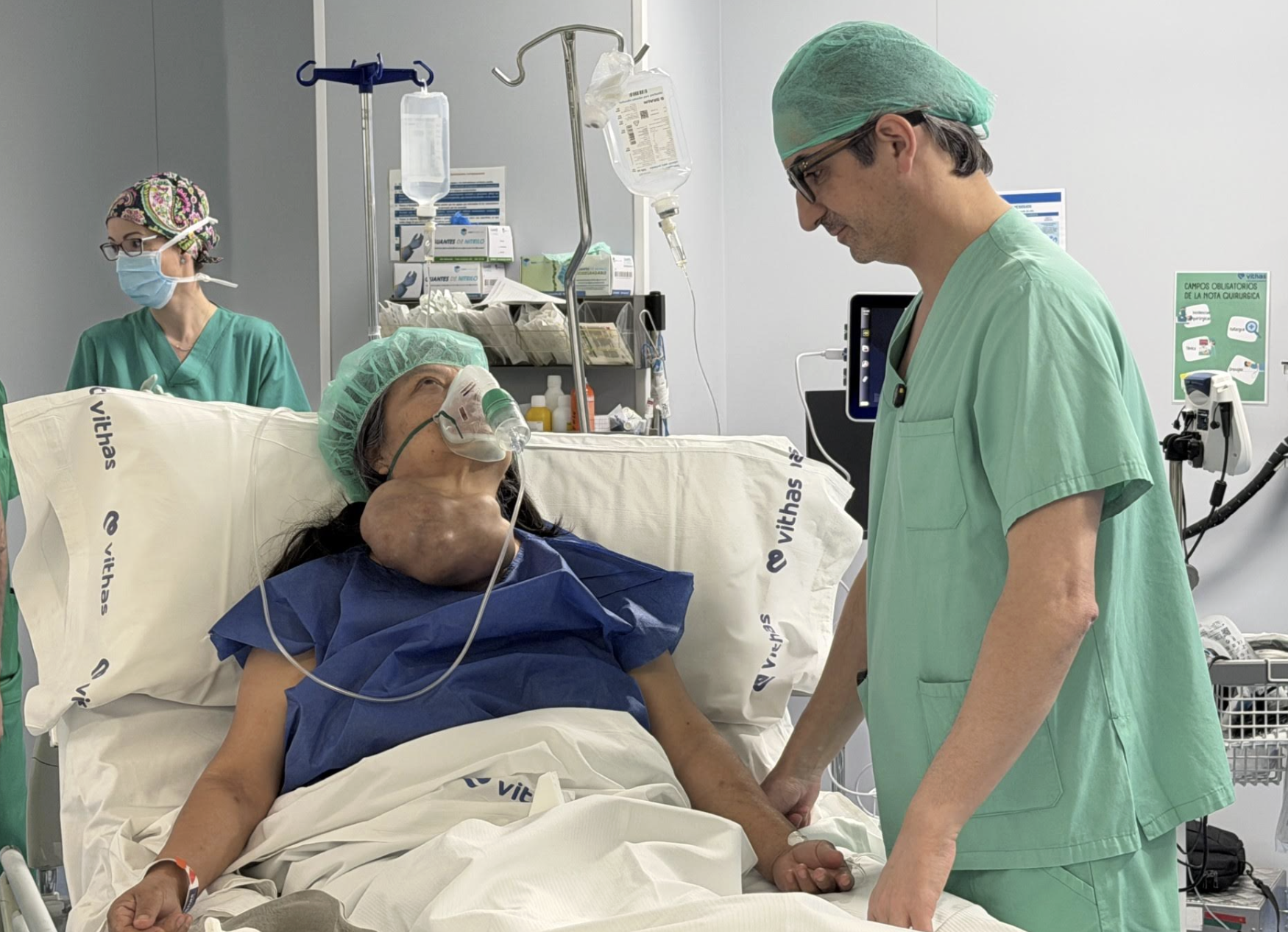
When healthcare systems fail, the Diego González Rivas Foundation builds a bridge. That is exactly what happened in the case of a Peruvian patient who had carried, for four decades, a giant tumor in her neck—weighing 1.3 kilograms—without finding a viable medical solution in her country. It was the Foundation that reviewed her case, took on the commitment to act, and coordinated her transfer to Spain to receive the treatment she needed.
The procedure was successfully performed at Vithas Madrid Aravaca University Hospital, a leading center in high-complexity surgery and a key partner of the Foundation in this case. A collaboration that proves that when the will to help meets medical excellence, the impossible becomes possible.
An exceptional team for an exceptional case
The surgery posed a major challenge: the tumor severely compressed the airway and had invaded vital cervical structures—the carotid artery, the jugular vein, and the main nerves of the neck—placing the operation at the very limits of technical feasibility.
To address it, a top-level multidisciplinary team was assembled. The intervention was led by Diego González Rivas, president of the Foundation and thoracic surgeon at Vithas Madrid Aravaca, together with Dr. Claudio Fragola, head of the hospital’s Otolaryngology Department. They were joined by Dr. Rafael Barberá, specialist in head and neck surgery; Dr. Ignacio Lojo, vascular surgeon; and Dr. Javier Gallego, from the Minimally Invasive Cardiothoracic Surgery Unit. Five specialists, seamless coordination, and a shared goal: to save a life.
Before proceeding with the tumor removal, it was necessary to perform an embolization of the arteries supplying the tumor—a technique that reduced surgical risk and allowed the intervention to be planned with maximum safety.
“The patient presented a giant neck tumor, with a four-decade evolution, which severely compressed the airway and posed a very high life-threatening risk. This is an extremely rare case of exceptional complexity,” explains Dr. Diego. “A multidisciplinary approach was essential, as well as having a center with the experience and resources of Vithas Madrid Aravaca.”
One of the most significant achievements was the complete preservation of the neck’s critical structures and the avoidance of a tracheotomy, ensuring the patient’s recovery with full functionality.
Medicine knows no borders
For the Foundation’s director, Carla Salgado, this case embodies the organization’s very purpose: “Faced with the lack of therapeutic alternatives in her country, we took on the commitment to study her case and make her surgery in Spain possible. Thanks to the involvement of an exceptional medical team and the collaboration of Vithas Madrid Aravaca Hospital, today this patient can regain something as essential as her life. This success is not only medical; it is a reminder that medicine knows no borders when there is a will to help.”
Cases like this are made possible by the Foundation’s ability to connect vulnerable patients—without access to treatment in their countries of origin—with top-tier medical teams and institutions willing to commit to something greater than their daily work.
Media impact
The story of this patient, and of those who made her recovery possible, went beyond the medical sphere to reach society at large. These are some of the media outlets that covered the story:
