
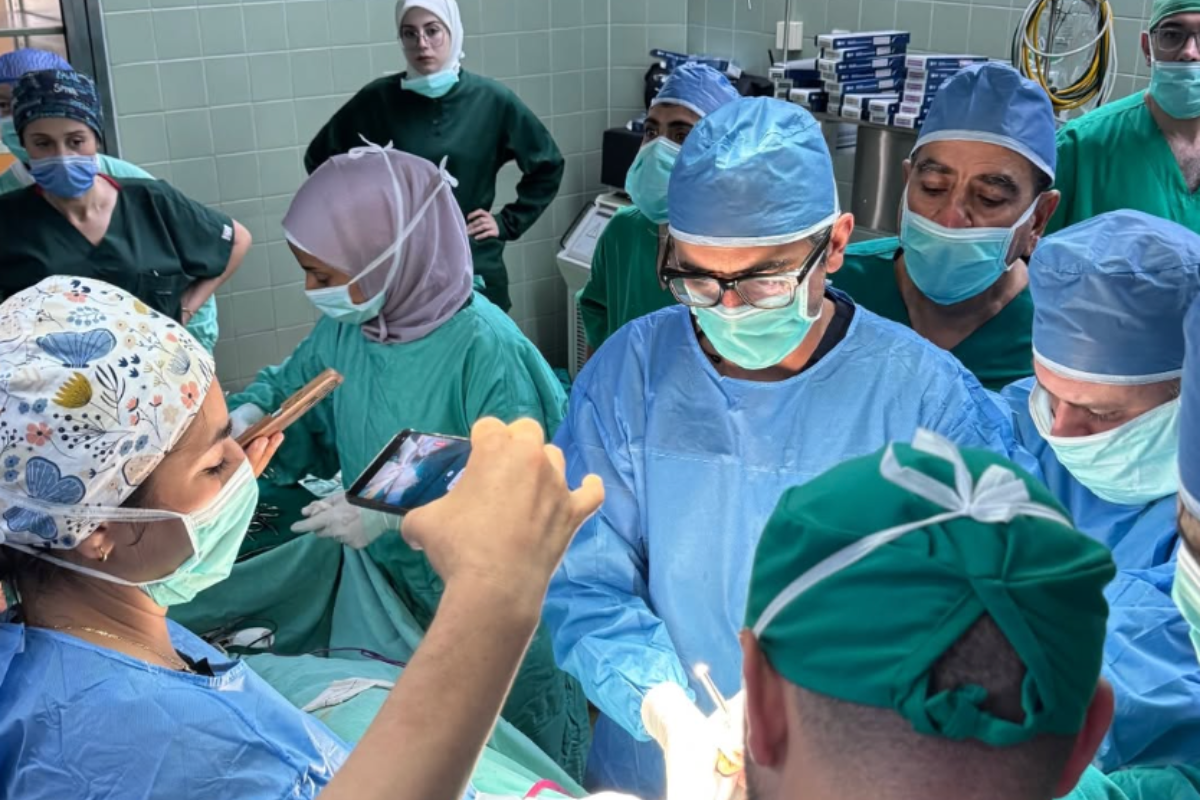
Doctor Diego González Rivas has delivered in Damascus the first Uniportal VATS surgery masterclass ever held in Syria, a milestone for the country’s thoracic surgery achieved as part of a new international mission by the Fundación Diego González Rivas. The course, held from 26 to 28 August at the National University Hospital in Damascus, combined lectures with four live surgical procedures and positioned the hospital among the region’s reference centres for minimally invasive thoracic surgery.
The event drew surgeons from across Syria and from neighbouring countries, all keen to watch the creator of the technique operate first-hand. Over three days, Doctor Diego alternated masterclass sessions with time in the operating theatre, demonstrating step by step an approach that allows the chest to be operated on through a single incision of two to three centimetres, without opening the ribcage.
The most talked-about moment came during one of the live surgeries, a left lower lobectomy to treat an arteriovenous malformation, a vascular anomaly rarely seen in an operating theatre, which Doctor Diego resolved under the close attention of dozens of specialists. “Very rare to see,” he remarked during the live broadcast, completing the resection with the same composure he brings to the most complex cases across the more than 140 countries where he has operated.
True to the purpose behind every Foundation mission, the day did not end in the operating theatre. Doctor Diego presented the Syrian team with a set of six surgical instruments — among them a dissector, a grasper, an aspirator and a curved spatula — so the hospital can keep practising minimally invasive surgery long after the visiting team has gone home.
“This is a donation for you, from our foundation, for your hospital, to help you improve minimally invasive surgery,” he said as he handed over the equipment. Because the ultimate aim of each mission is not only to operate, but to leave behind, in every country, a team able to carry the work forward on its own.
That logic takes on particular weight here. Damascus is home to some of Syria’s leading university hospitals and to much of the training of its doctors, in a country whose health system still bears the strain of more than a decade of war. According to the United Nations, 12.8 million people are in need of health assistance in Syria in 2026, and only 57% of hospitals and 30% of primary care centres are fully functional, held back by shortages of staff, equipment and supplies.
In that context, teaching the technique and donating instruments is no symbolic gesture, but a way of leaving installed medical capacity that remains once the international team has departed.
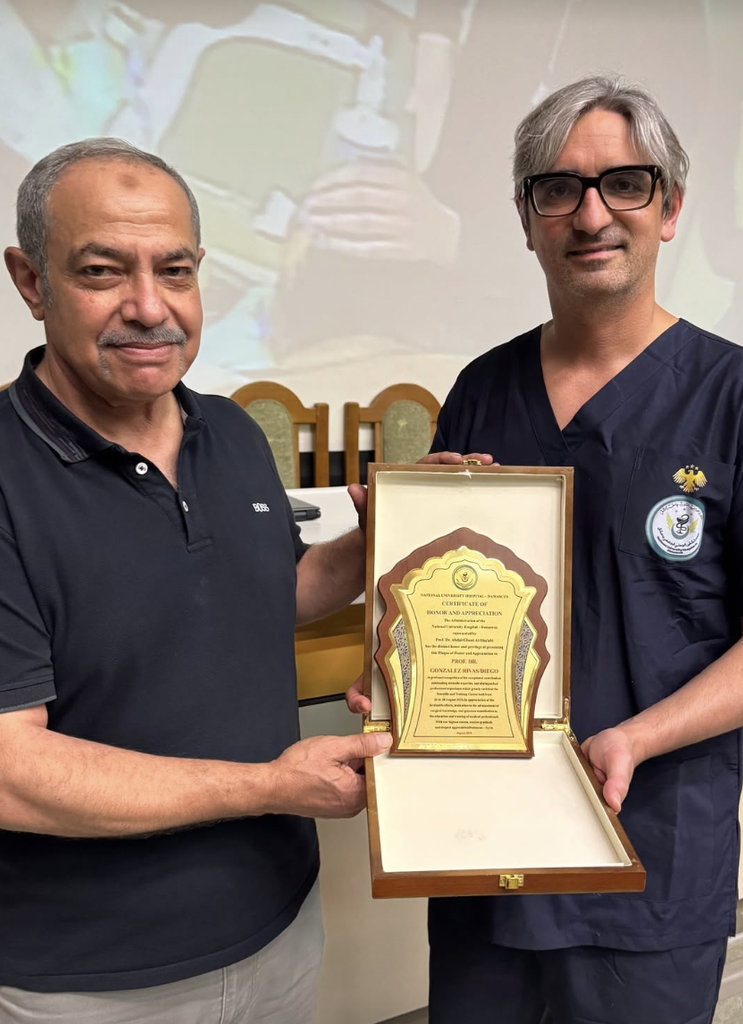
The National University Hospital in Damascus honoured Doctor Diego with a plaque of appreciation for his contribution to the training of its specialists, and Syrian national television covered a visit that, for many of the country’s surgeons, marked their first direct encounter with the technique. As in its most recent missions, the work was carried out entirely within a partner hospital, with Doctor Diego operating alongside the local team and without the need to deploy the Mobile Surgical Unit.
With this first visit to Syria, the Fundación Diego González Rivas adds another country to the network of international hospital missions through which it brings advanced thoracic surgery to those whom geography or resources keep it out of reach.
Damascus is one more stop in an extraordinary August that has taken Doctor Diego to seven countries across four continents in a single month, with further missions already planned for Chad and Sierra Leone. There, as in Damascus, minimally invasive thoracic surgery remains, for many patients, the only door open to treatment they would otherwise never be able to reach.
